Dongguk Device Recognizes Activities Without Batteries
Self-powered flexible neuromorphic device from Dongguk University classified six human activities with 88.05% accuracy while bent.
By Academic Writing Club Newsroom
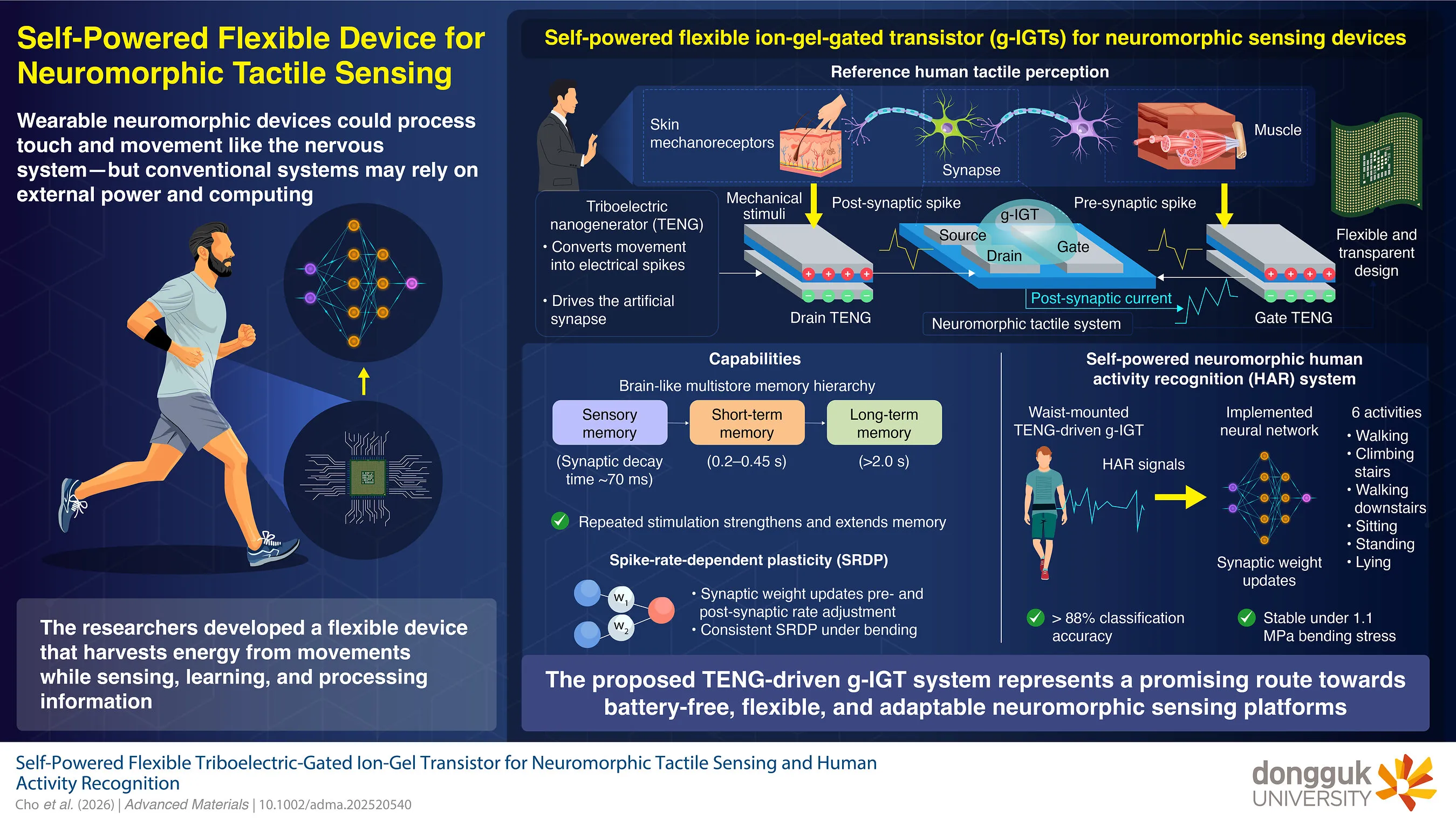
Dongguk University researchers have developed a flexible, self-powered neuromorphic sensing device that classified six human activities with 88.05% accuracy while bent. The battery-free system combines two triboelectric nanogenerators with a graphene-channel ion-gel-gated transistor. It recorded sensory memory lasting about 70 milliseconds, short-term memory lasting 0.2 to 0.45 seconds, and long-term memory lasting more than 2 seconds. The research was published in Advanced Materials.
Mechanical Signals Power Learning
Triboelectric nanogenerators convert movement, touch, or vibration into electrical signals. In the device, one generator supplies pre-synaptic spikes and another supplies post-synaptic spikes, allowing the transistor to respond without an external power source.
Professor Sejoon Lee, Professor in the Department of System Semiconductor at Dongguk University, said:
“In human tactile perception mechanoreceptors sense even minute mechanical disturbances and convert them into neural spikes. To replicate this process electronically, we integrated a triboelectric nanogenerator with a g-IGT that converts mechanical stimuli into electrical signals that directly regulate artificial synaptic behavior without requiring external power.”
Activity Recognition Under Bending
The researchers used the device’s measured synaptic behavior in a single-layer artificial neural network for human activity recognition. Using publicly available motion data, the system identified walking, sitting, standing, lying, walking upstairs, and walking downstairs. It retained more than 75% accuracy in high-noise conditions, though performance fell under extreme signal distortion.
Wearable Sensing Applications
The work could support self-powered wearable health-monitoring devices, electronic skin, smart prosthetics, human-machine interfaces, and motion-monitoring systems. Its learning function remained stable under bending, a relevant result for flexible devices that must operate during movement.
Professor Sejoon Lee, Professor in the Department of System Semiconductor at Dongguk University, said:
“Our research could contribute to a new generation of wearable artificial intelligence systems that operate with minimal reliance on batteries or external computing resources. More broadly, our work points toward self-powered neuromorphic electronics with integrated sensing, memory, learning, and information processing in a single flexible platform.”