Chonnam Tests Dichloromethane for Amide Synthesis
Chonnam amide synthesis study reports a dichloromethane method that produced more than 20 grams of moclobemide at over 99% purity.
By Academic Writing Club Newsroom
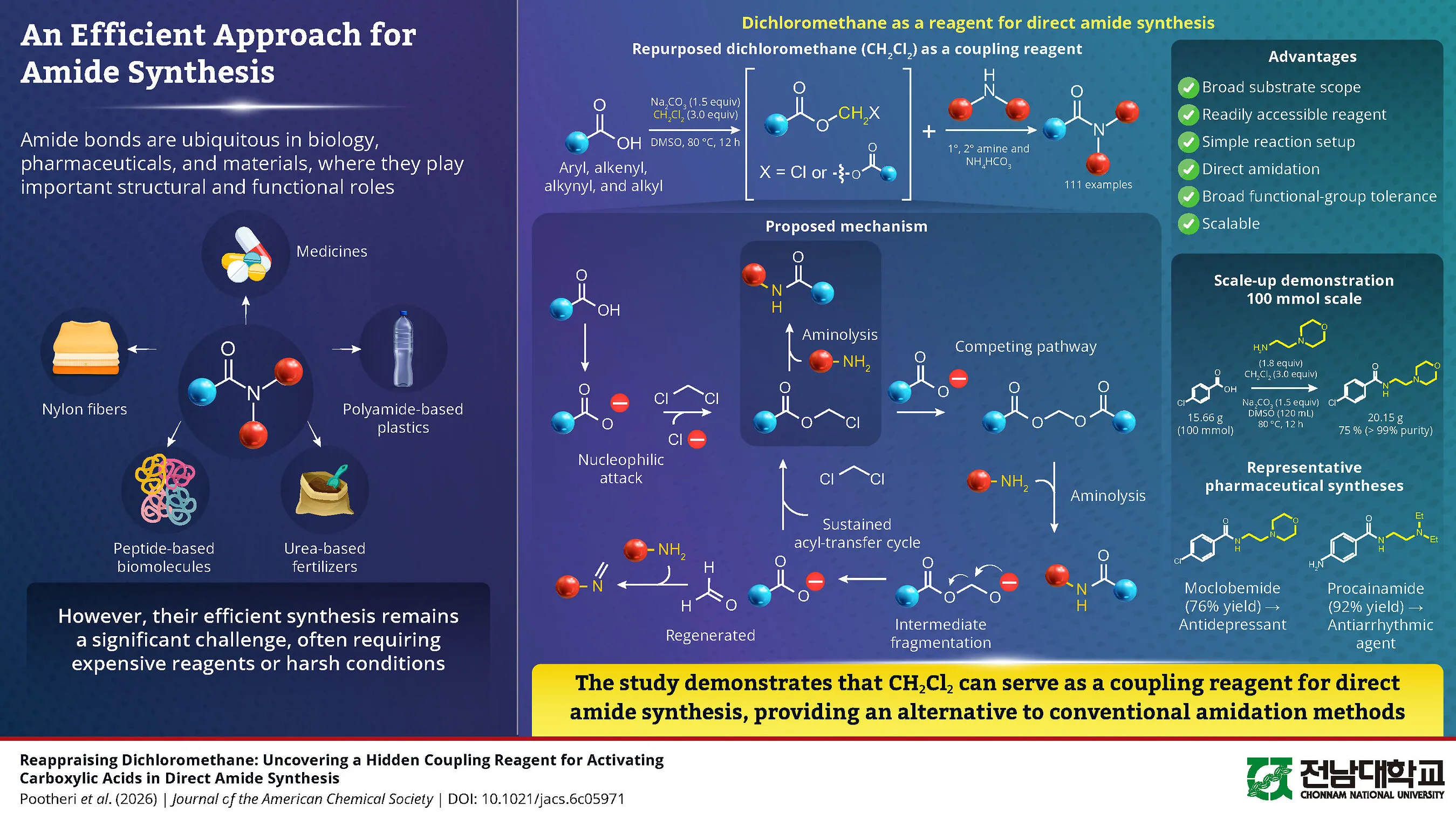
Chonnam National University researchers produced procainamide at 92% yield and moclobemide at 76% yield using dichloromethane in direct amide synthesis. A 100 millimole scale-up reaction produced more than 20 grams of moclobemide at greater than 99% purity. The team used dichloromethane, a commonly used solvent, as a coupling reagent with carboxylic acids and amines. The study appeared in the Journal of the American Chemical Society on July 15, 2026.
Using A Common Solvent
Amide bonds link amino acids in proteins and are used in medicines and polymers. Conventional methods often activate carboxylic acids with coupling reagents before they react with amines, but these reagents can be corrosive or toxic, create hazardous byproducts, and generate waste.
Sunwoo Lee, Professor in the Department of Chemistry at Chonnam National University, said:
“Dichloromethane is a commonly used solvent in many chemical processes. In this study, we present the successful application of this common solvent to facilitate efficient and scalable amide bond formation.”
Reaction Conditions And Results
Under basic conditions, the team found that carboxylates can react with dichloromethane to form chloromethyl ester intermediates, which then react with amines to produce amides. The optimized reaction used sodium carbonate, dichloromethane, dimethyl sulfoxide, 80 °C, a 12-hour reaction time, and an excess of amine.
The researchers also reported direct single-step amide synthesis using carboxylic acids and ammonium bicarbonate. Their scale-up test combined 4-chlorobenzoic acid and 2-morpholinoethanamine.
Reducing Coupling Reagent Waste
The researchers reported two reaction pathways, including one in which a carboxylate attacks dichloromethane to form an activated ester.
Sunwoo Lee, Professor in the Department of Chemistry at Chonnam National University, said:
“By avoiding many conventional stoichiometric coupling reagents and reducing coupling-reagent-derived waste, our approach demonstrates that dichloromethane can provide a practical and scalable alternative for amide synthesis.”