Impact Direction Changes AZ31 Magnesium Alloy Response
AZ31 magnesium alloy ballistic performance improved by 6.5% to 6.7% when impacts followed the normal direction, Pusan researchers found.
By Academic Writing Club Newsroom
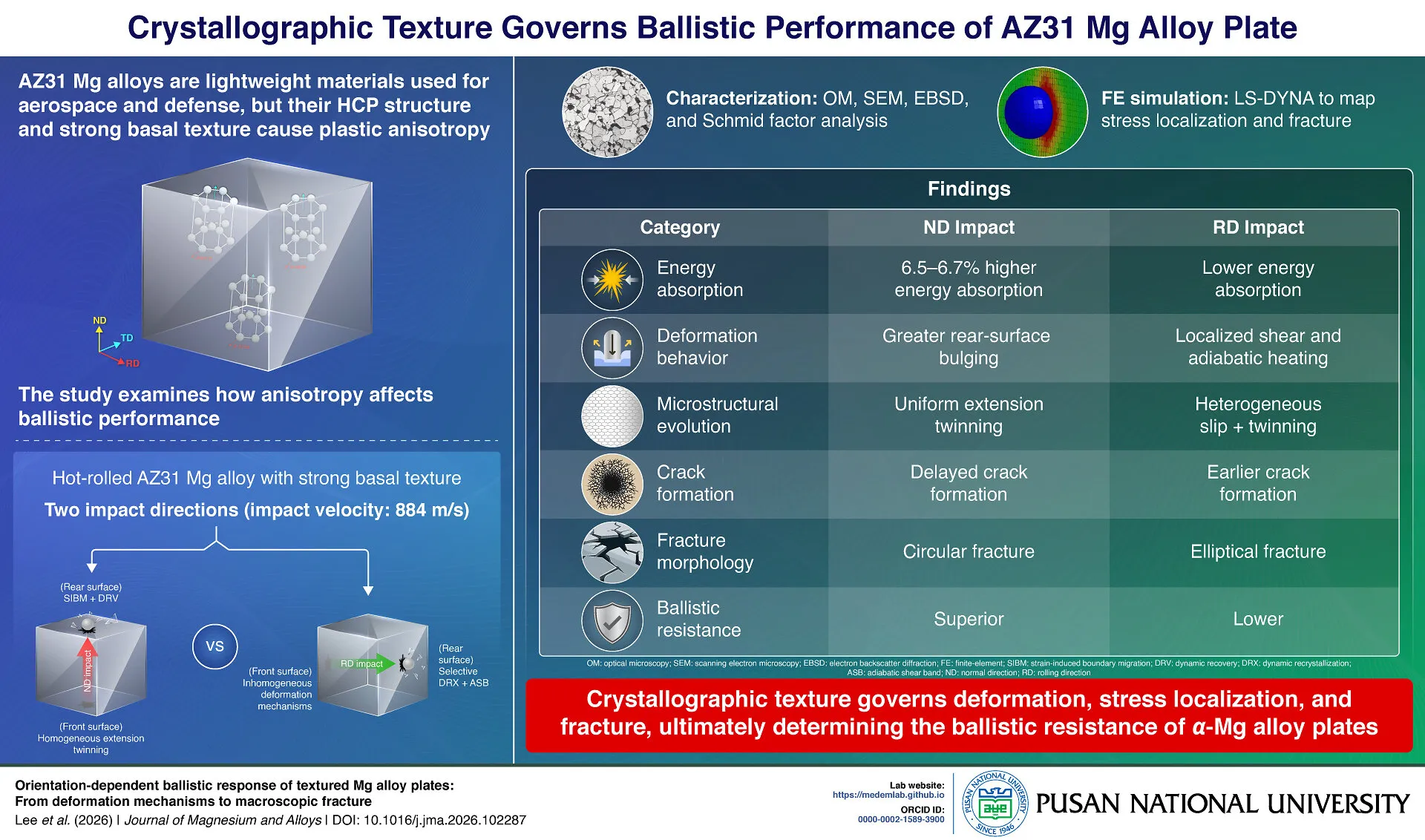
Pusan National University researchers found that AZ31 magnesium alloy plates absorbed 6.5% to 6.7% more energy when struck along the normal direction than along the rolling direction. The study tested plates 5 to 20 mm thick at about 884 m/s. Seoul National University and Kyungpook National University collaborated on the research. The findings were made available online September 26 and are scheduled for publication in the Journal of Magnesium and Alloys on November 1, 2026.
Different Fracture Patterns
The team evaluated projectile velocity, energy absorption, penetration, bulging, and fracture behavior under impacts along two directions. Plates struck along the normal direction showed symmetric fractures after perforation. Thicker plates that resisted full perforation bulged rather than cracked.
Professor Taekyung Lee said:
“Plates impacted along the ND consistently absorbed 6.5–6.7% more energy and fractured in a symmetric manner upon perforation. In thicker plates that resisted full perforation, ND impact promoted bulging rather than cracking. By contrast, impact along the RD produced localized shear bands and asymmetric, elliptical fractures.”
Texture Guides Design
Microstructural analysis and finite-element simulations linked the different outcomes to deformation mechanisms within the alloy. Normal-direction impacts promoted uniform extension twinning and more even stress distribution, while rolling-direction impacts produced heterogeneous slip and twinning, shear localization, heating, and dynamic recrystallization.
Professor Taekyung Lee said:
“Instead of inventing a new alloy or adding weight, engineers can boost ballistic resistance simply by orienting the plate so that impacts arrive along the direction in which its texture promotes uniform, symmetric deformation. This is essentially "free" performance extracted from material that already exists.”
Implications For Lightweight Protection
The research identifies crystal texture and component orientation as design variables for magnesium alloy protection. The authors said further research is needed to assess the approach under more complex impact conditions.