SeoulTech AI Improves SSD Failure Predictions
SSD failure prediction research from SeoulTech retained an F1 score of 0.717 with a simulated 40% false-failure rate.
By Academic Writing Club Newsroom
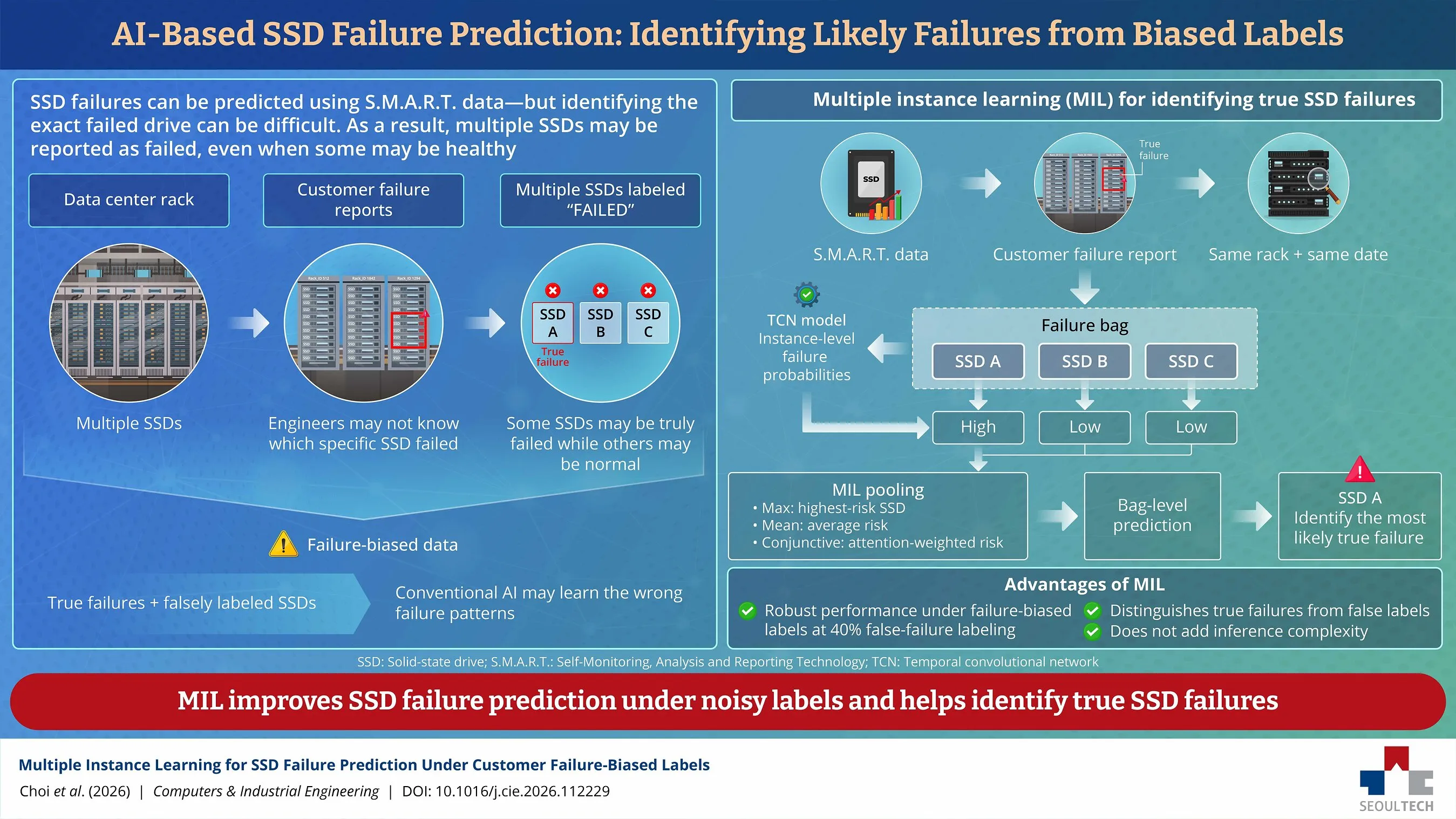
Seoul National University of Science and Technology researchers developed an AI approach for SSD failure prediction that retained an F1 score of 0.717 with a simulated 40% false-failure rate in training data. The work was conducted with Samsung Electronics using real-world SSD data from an Alibaba Cloud data center. Under the same condition, a conventional model recorded an F1 score of 0.261, down from 0.731 when there were no false-failure labels. The study was made available online on July 6, 2026.
Training With Imperfect Reports
SSDs generate S.M.A.R.T. logs containing information on errors, wear, and operating conditions. When an abnormal event occurs, several drives in the same rack may be reported as failed, even when healthy drives were not responsible. These inaccurate labels can mislead machine-learning models trained to estimate failure risk.
Dr. Shim, said:
“Industrial AI has to work with the data that are actually available in the real world, and those data are not always perfectly labeled. Our goal was to develop a way for AI to learn from these imperfect failure reports without assuming that every reported SSD failure is correct.”
Individual Risk From Group Reports
The team used Multiple Instance Learning to group SSD data from drives in the same rack with failure reports on the same date. A temporal convolutional network analyzed each drive’s S.M.A.R.T. data over time, estimating individual failure risk while learning from group-level reports.
The model ranked true failures at an average of 1.6, compared with 3.5 for healthy SSDs incorrectly reported as failed. The approach could help data-center operators prioritize inspections, backups, monitoring, and SSD replacements.
Uses Beyond Data Centers
The method may also be useful in industrial settings where a problem can be identified within a group but the component responsible is difficult to determine. Potential applications include battery packs and industrial machinery.
Dr. Shim, said:
“The idea is not limited to SSDs. It could also be useful for other industrial settings such as battery packs, industrial machinery and other systems where a problem can be identified within a group, but the exact component responsible is difficult to determine.”