Hanbat Study Reports Faster Lithium-Metal Batteries
Bikitaite-infused cellulose separator improves NCM90 battery capacity at 4C and supports lithium-metal battery stability in a Hanbat study.
By Academic Writing Club Newsroom
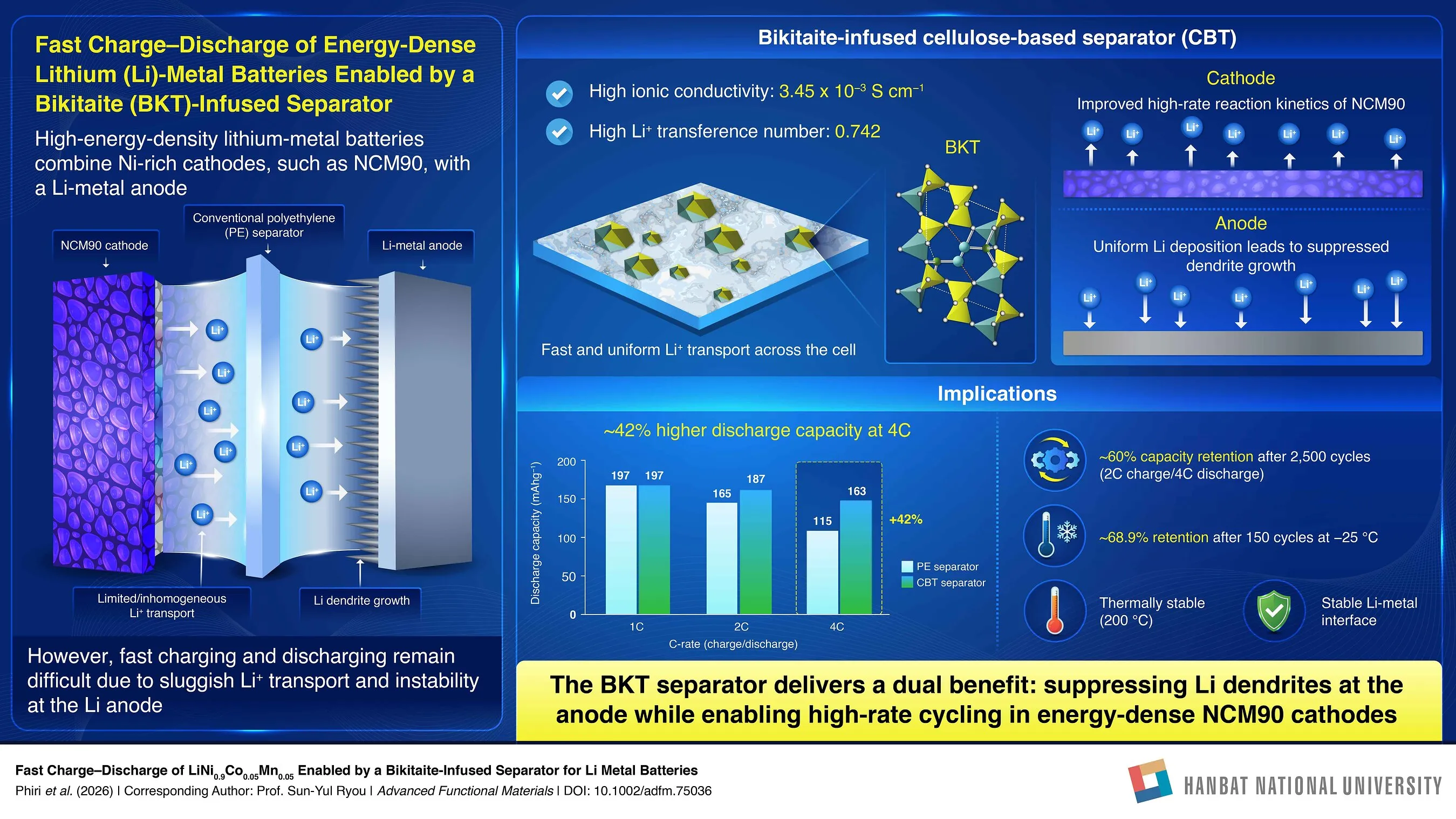
Hanbat National University researchers have developed a bikitaite-infused cellulose separator for lithium-metal batteries with NCM90 cathodes. The CBT separator recorded ionic conductivity of 3.45 × 10⁻³ S cm⁻¹ and a lithium-ion transference number of 0.742. At a 4C discharge rate, cells using CBT delivered 163 mAh g⁻¹, compared with 115 mAh g⁻¹ using a conventional polyethylene separator, an improvement of about 42%. The study was published in Advanced Functional Materials in July 2026.
Higher Rate Performance
The separator combines cellulose’s porous structure with bikitaite zeolite to create pathways for lithium-ion movement. At 1C, CBT and conventional polyethylene separators both delivered about 197 mAh g⁻¹. At 2C, the capacities were 187 mAh g⁻¹ with CBT and 165 mAh g⁻¹ with the conventional separator.
Sun-Yul Ryou, Professor at Hanbat National University, said:
“Our results show that battery performance can be improved not only through new cathode and anode materials, but also through separator engineering. What was particularly interesting was that the effect of the modified separator extended beyond the lithium-metal anode and significantly improved the high-rate performance of the NCM90 cathode,”
Stability Under Demanding Conditions
Real-time observation found no visible dendrite growth in CBT-equipped cells. The cells retained about 60% capacity after 2,500 cycles at 2C/4C, about 68.9% after 150 cold cycles at −25 °C, and remained stable at 200 °C. Testing in commercial pouch or cylindrical battery formats is still needed.
Sun-Yul Ryou, Professor at Hanbat National University, said:
“Functional separators should not be viewed only as barriers that separate the two electrodes or as a means of protecting the lithium-metal anode. By controlling ion transport across the cell, they could become an important design element for simultaneously achieving high energy density and high-rate operation in next-generation batteries,”