Hanbat Study Tests Disorder in Lithium-Rich Cathodes
Cation disorder in lithium-rich cathodes improved capacity, high-current performance, and stability in a Hanbat National University study.
By Academic Writing Club Newsroom
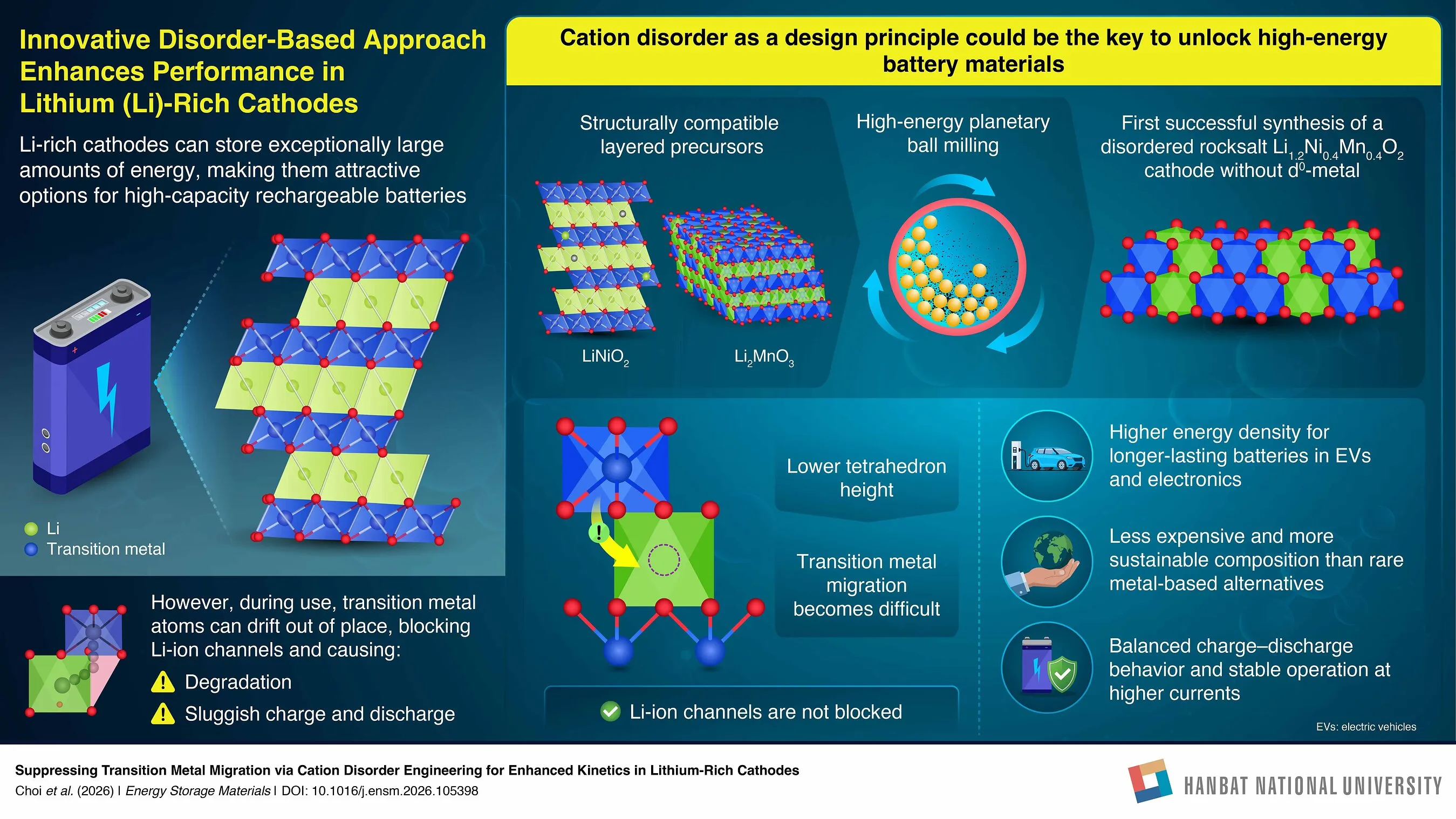
Hanbat National University researchers reported a lithium-rich cathode that retained about 90% of its initial capacity after 50 cycles without a voltage reduction. The team intentionally introduced cation disorder into Li1.2Ni0.4Mn0.4O2, a nickel-manganese material that avoids cobalt. Their study found that the disordered material delivered higher capacity, more symmetric charge-discharge behavior, and better high-current performance than its ordered counterpart. The research was published in Volume 90 of Energy Storage Materials on August 1, 2026.
Testing A Disordered Structure
Lithium-rich cathodes can offer higher energy density for electronics and electric vehicles, but transition metal ions may migrate during operation and block pathways used by lithium. Professor Kyojin Ku’s team tested whether disrupting the material’s normally layered structure could address that problem.
The researchers used high-energy ball milling with two structurally compatible layered starting materials. The mechanochemical process produced a rock-salt structure in which lithium, nickel, and manganese ions were distributed more randomly.
Prof. Kyojin Ku, faculty member in the Department of Materials Science and Engineering at Hanbat National University, said:
“To our knowledge, this is the first time this type of composition has been made in the disordered form.”
Lithium Transport And Stability
The disordered cathode retained about 90% of its initial capacity after 50 cycles and showed no reduction in voltage. The team’s theoretical and computational analysis examined how the altered atomic arrangement affected lithium transport and transition-metal movement.
Prof. Kyojin Ku, faculty member in the Department of Materials Science and Engineering at Hanbat National University, explained:
“By deliberately scrambling the atoms into a disordered rock-salt arrangement, we decoupled the movement of lithium from the harmful movement of the transition-metals. Lithium still flows efficiently through a connected network of open pathways, while the transition-metals become effectively locked in place and can no longer block those pathways.”
A Route For Cathode Research
The findings position cation disorder as a possible design method for lithium-rich cathodes, rather than solely a structural problem to prevent.
Prof. Kyojin Ku, faculty member in the Department of Materials Science and Engineering at Hanbat National University, concluded:
“We have shown that cation disorder can be used as a deliberate engineering tool to solve a problem that has held back an entire family of high-energy battery materials for years.”